


Using Picture Symbols to
Facilitate Communication
Individuals who are unable to communicate orally often communicate by pointing to picture symbols on communication boards. Students with developmental disabilities may require very simple symbols to express basic needs. These individuals frequently have difficulty responding to pictures that include too many lines and too many details. The Library of International Picture Symbols (LIPS) has grown in popularity in recent years because it includes thousands of easy-to-identify symbols that can be adapted easily for use in different cultures. In addition to including foods and items that are commonly used in the United States, the symbol system includes items relevant to the experiences of people from diverse cultural backgrounds. Taiwan, Japan, and others countries are using the symbols to create communication boards and overlays for augmentative communication devices.
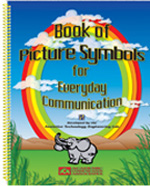 The Book of Picture Symbols for Everyday Communication, published by Academic Communication Associates,features thousands of the most widely used LIPS symbols. This book is helpful in designing instructional activities and communication boards for students who use augmentative/alternative modes of communication such as AAC devices. Because of their bilingual/multicultural emphasis, Academic Communication Associates in now using this system in selected products for individuals with special needs. Popular books using these symbols include the following:
 - Bilingual Picture Symbol Communication Resource
- Book of Picture Symbols for Everyday Communication
- Communication Board Activities for Special Learners
- Picture Symbol Language Activity Book
- Picture Symbol Stories for Special Learners
- Book of Picture Symbols for Everyday Communication
- Communication Board Activities for Special Learners
- Picture Symbol Language Activity Book
- Picture Symbol Stories for Special Learners
Picture symbols may be used in conjunction with photos to create communication boards. Software programs designed for this purpose are available at this link: View program information
Source: ACA Special Education News, 2006 (Volume 1). Published by Academic Communication Associates, P.O. Box 4279, Oceanside, CA 92052-4279 Website: acadcom.com
Recommended Readings: Assistive Technology Engineering Lab, Book of Picture Symbols for Everyday Communication. Oceanside, CA: Academic Communication Associates
Citation for this Article:
Academic Communication Associates. (2007). Using picture symbols to facilitate communication. ACA Special Education News, Article 7-2
Copyright 2007 by Academic Communication Associates
Academic Communication Associates, Inc.
P.O. Box 4279
Oceanside, CA 92052-4279
website: acadcom.com
P.O. Box 4279
Oceanside, CA 92052-4279
website: acadcom.com
Easy to remember connection to the home page of the ACA WEBSITE: https://acadcom.com/